

Once a shuttered relic of Staten Island’s past, the St. George Theatre stands as a cornerstone of the community once again – thanks to three determined women. Today, bolstered by a powerful partnership with Staten Island University Hospital, the theater continues to enrich the borough in meaningful ways.
BY AMANDA McCOY • PHOTOS BY AMESSE PHOTOGRAPHY
When the St. George Theatre first opened its doors in 1929, it was far more than a venue. It was a vision. Built as a “dream” show house to rival Manhattan’s grandest cinema palaces, the 2,800-seat landmark dazzled with gilded balconies, sweeping staircases, stained glass chandeliers, and ornate Spanish and Italian Baroque interiors. Vaudeville stars illuminated the stage, and for decades, the theater stood as one of Staten Island’s brightest cultural beacons. But by the late 1970s, its lights went dark. What followed were decades of silence – failed reinventions, abandoned plans, and a once-majestic space left to deteriorate behind locked gates. That might have been the end of the story, if not for three Staten Island women who refused to let the magic dwindle to dust.
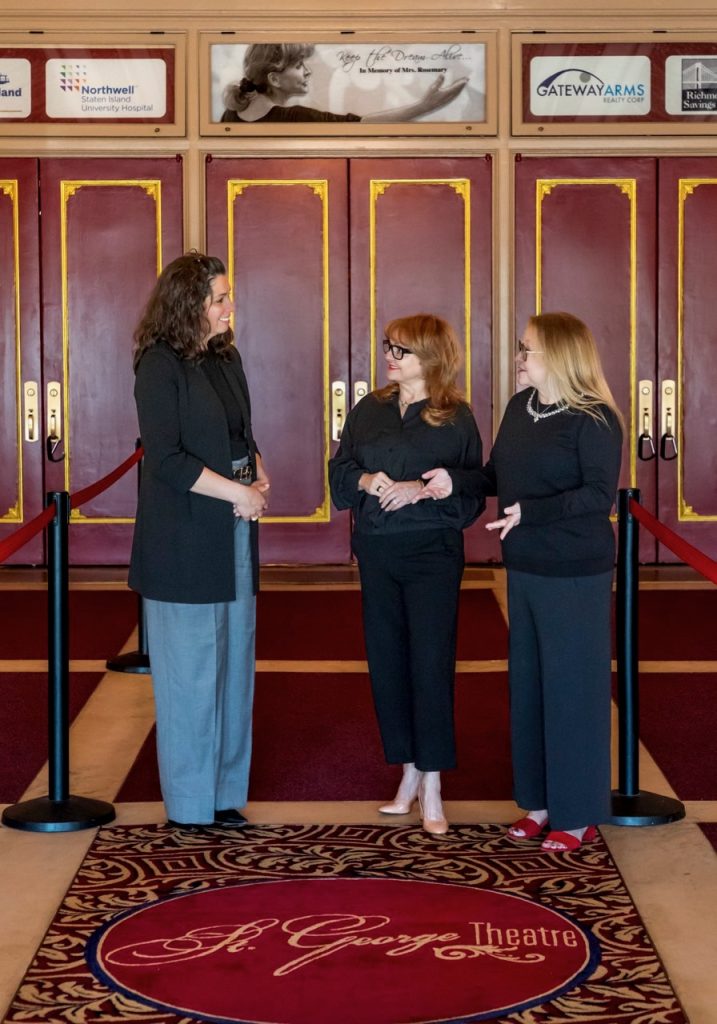
In 2004, Rosemary Cappozalo and her daughters, Doreen Cugno and Luanne Sorrentino, founded a nonprofit with a singular mission: save the St. George Theatre. When they first stepped inside, the building was in near ruin: no electricity, no plumbing, collapsed ceilings, water pouring through gaping holes. “There was nothing,” recalled Doreen Cugno, who serves as the theater’s president and CEO today. “No seats, no stage, no lighting – nothing.” Yet where others saw a lost cause, the trio saw possibility.
Driven in part by Cappozalo’s deep personal connection – she had grown up attending performances at the theater – the effort became both a preservation project and a labor of love. Cappozalo even donated over $1 million of her own life savings to help jumpstart the restoration. With the support of the community, elected officials, and business leaders, the women moved swiftly, reopening the theater within months and continuing to restore it piece by piece. This was not a renovation, but a revival – one rooted in historical accuracy, from the original color palette to the intricate carpet designs.

Today, the St. George Theatre stands as a triumph of resilience and vision, often cited among the most beautiful theaters in the country and widely considered Staten Island’s answer to Radio City Music Hall. Just as significantly, it has helped transform the surrounding St. George neighborhood from what Sorrentino described as a “ghost town” into a thriving destination filled with restaurants, bakeries, and bustling foot traffic. “We ushered in the revitalization of the entire area,” she said. “Today, it’s an experience.”
This spirit of community transformation extends far beyond the stage. Since the early 2010s, the St. George Theatre has been working closely with Staten Island University Hospital, a collaboration rooted in a shared mission to improve health and quality of life across the borough. The connection began through a mutual board member, but quickly evolved into a multi-faceted partnership that blends the arts, education, and wellness.
“We love Staten Island,” said Cugno. “It’s important to us to enrich the lives of the people who live here and give them access to the arts. SIUH has the same goal: making sure people have access to the best care right here in the borough. If we can work together to provide more, why wouldn’t we?”
One of the most impactful examples of this collaboration is the theater’s annual Summer Arts Intensive, a two-and-a-half-week program for students ages 9 to 18 that combines performance training with life skills and personal development. For many participants – particularly those who may not otherwise have access to an arts program – it’s a transformative experience.
“When we took over, there was no marquee outside, so you’d have no idea it was a theater,” said Sorrentino. “There was a high school around the block, and soon kids started walking in. Our mother was a prominent dance educator, and she told the kids to come back later that afternoon and we’d teach them how to dance. That’s how the program started, and 23 years later, it lives on.”
Each summer, SIUH plays an active role in the intensive, leading sessions focused on health and nutrition. Hospital representatives teach students how to make smart dietary choices, how to balance meals, and how to care for their bodies – lessons that complement the program’s broader focus on confidence, communication, and self-expression. “It’s one of our favorite parts of the program,” said Cugno. “We’re not just teaching kids how to perform; we’re helping set them up for success in life.”
The program culminates in a full-scale production on the St. George stage, giving students the chance to perform in a venue once graced by legends. For many, it’s a defining moment, one that reinforces the theater’s role not just as a performance space, but as a community incubator.
The partnership with the hospital continues throughout the year. At checkout, theatergoers are invited to donate one dollar to the Brian Halpin Pediatric Cancer Center located within the Florina Cancer Center at SIUH, a small gesture that has grown into a meaningful annual contribution. Every holiday season, the theater presents the hospital with a check during its prized Christmas show, raising both funds and awareness for pediatric cancer care on Staten Island.
That Christmas show has become a beloved local tradition in its own right. Featuring a live orchestra and a cast of more than 100 volunteers, it offers families a festive, high-quality experience close to home. This past year, the theater extended that tradition even further, bringing a filmed version of the production directly to children at SIUH, including those in the cancer unit, ensuring that even patients who couldn’t attend in person could still be part of the magic.
For Cugno and Sorrentino, who are continuing the work, passion, and legacy of their late mother, the partnership is a natural extension of everything the theater stands for: access, enrichment, and community, proof that when culture and care come together, the impact reaches far beyond the stage. “Saving the theater took a village,” Cugno said. “And everything we do now is about giving back to that village.”
St. George Theatre — stgeorgetheatre.com